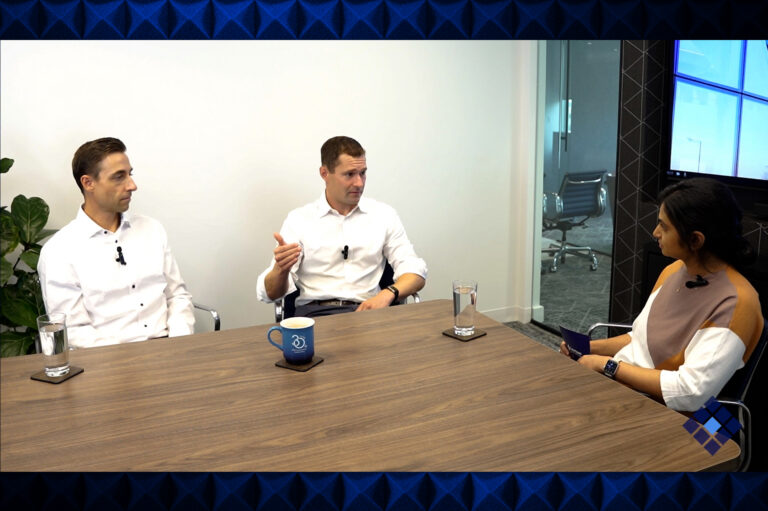
Among the many questions surrounding the development of AI is the challenge of how we develop AI sustainably as it grows and becomes integral across all industries and our daily lives. This episode of the Front & Center podcast examines that challenge.
Senior Investment Strategist and Global Head of Sustainability Uma Moriarity is joined by Christopher Wellise, Vice President of Global Sustainability at Equinix, to correct the narrative around AI development and dispel the idea that every new gigawatt of AI infrastructure is working against climate goals. From finding the balance between rapid growth and responsible resource use to the efficiency innovations emerging as a result, Uma and Christopher discuss the reality of data center development and the opportunities that exist to drive sustainable innovation.
00;00;00;04 – 00;00;20;10
Chris Wellise
The future really belongs to organizations that can turn sustainability from a constraint into a competitive advantage. And that’s really what we’re focused on investing in infrastructure that strengthens communities, connectivity, resilience and public services.
00;00;20;13 – 00;00;34;22
Intro
Hello and welcome to Front and Center, a show dedicated to insights and perspectives on commercial real estate investment across the public and private markets. For more information, please visit Center square.com.
00;00;34;24 – 00;01;01;06
Uma Moriarity
Welcome back to Front and Center. I’m Uma Moriarity, senior investment strategist and global head of sustainability here at CenterSquare. Today we’re diving into one of the most talked about and actually maybe even most misunderstood corners of the built environment, which is data centers between the AI driven demand that we’re seeing, the wave of headlines about power grids, water use, it’s never been harder, I think, to really separate the signal from the noise in this conversation and to help us do exactly that.
00;01;01;07 – 00;01;19;06
Uma Moriarity
I’m joined by Christopher Wallace. He is the vice president of global sustainability at Equinix, and he has spent his career at the intersection of technology and climate strategy, from Hewlett-Packard to Amazon Web Services, and now leading sustainability for one of the world’s largest data center operators. Christopher, welcome to the show.
00;01;19;09 – 00;01;21;25
Chris Wellise
Thanks so much for having me on. I appreciate it.
00;01;21;27 – 00;01;45;00
Uma Moriarity
So maybe just really diving into why this is such an important conversation today. AI data centers, the energy transition, they’ve all collided into one of what seems like most defining infrastructure stories of this decade. Having worked inside so many different organizations that are tied up in this particular part of the world, why does this intersection matter so much right now?
00;01;45;02 – 00;02;06;18
Chris Wellise
Yeah, I mean, it’s interesting. So I guess depending upon how I sort of look at the evolution of my career, I’m either moving up the stack or down the stack. I started it really at HP, which was largely around building server storage and networking equipment, and then went move to cloud at AWS and now here at Equinox, which is really foundational infrastructure.
00;02;06;18 – 00;02;49;09
Chris Wellise
And I think as you sort of touched on in your opening comments, the question isn’t really whether I will grow. The question is whether we can grow AI responsibly. I think that’s kind of the modality that we’re in at the moment. It’s really all about converting electrons into tokens, and I think we’re in that massive growth phase. So we’re going to have some catch up to do while we consider issues around national security winning the AI race when it comes to us, compared to whether you compare us to, say, China or or other leading countries that are also entering that race, I think it’s really ultimately going to be a question of whether or not
00;02;49;09 – 00;02;54;11
Chris Wellise
we can do so in a sustainably enabled way.
00;02;54;14 – 00;03;13;02
Uma Moriarity
Yeah, absolutely. And I think given your career, you have seen how much this industry in general has always held itself to a really high sustainability bar for many years. And it seems like that bar just keeps on climbing because of exactly what you said. What’s pushing it there higher now, in terms of the work that’s being done on the ground?
00;03;13;02 – 00;03;18;03
Uma Moriarity
And how does today’s pace maybe compare to what you saw earlier in your career?
00;03;18;06 – 00;04;06;11
Chris Wellise
I think there’s a number of different reasons why technology, large technology companies have really been at sort of the epicenter of sustainability. I mean, a lot of it is simply around the flow of capital in the companies, which is not just true today around AI and the built infrastructure. It was true ten, 15 years ago as well, sort of the rise of the software companies, the rise of companies like meta than Facebook, the rise of just digital infrastructure more broadly, I think civil society has often looked to leading technology companies to really set the bar for sustainability and for better or worse, sometimes we’ve often been the target of sustainability related activism, and I think
00;04;06;11 – 00;04;40;05
Chris Wellise
we’ve responded in kind. Right. If you think about the primary way that grids are green today is largely a result of a core group of a small handful of technology companies. 10 or 12 years ago that really began to develop the whole concept of the utility scale PR and then drive those into the grid, resulting in, I think, cleaner energy for all users associated with and attached to the grids that we use for our operations.
00;04;40;05 – 00;04;57;16
Chris Wellise
So it’s largely the high visibility associated with the core group of companies that are really placed in that leadership position. But also we tend to push ourselves. And I think the leaders within those companies tend to set a high bar for themselves as well.
00;04;57;18 – 00;05;18;22
Uma Moriarity
Yeah, absolutely. And going back to maybe the the narrative. Right. So there’s this narrative today, which is very different than maybe what the narrative was, more data center perspective even five years ago. But the narrative is like every new gigawatt of AI infrastructure is working against climate goals. I know that you and many of your peers are really working to do completely the opposite.
00;05;18;22 – 00;05;36;07
Uma Moriarity
So what’s the maybe the more accurate story about how data and our growth is actually intersecting with the build out of clean energy? I mean, you provided a really great example of the way in which technology companies, many years ago went through a process through which the grid in general is becoming greener. So what’s happening, really, from a data center perspective?
00;05;36;12 – 00;05;38;00
Uma Moriarity
In the same vein.
00;05;38;02 – 00;06;15;22
Chris Wellise
You mean, I think it’s I mean, look at it at a high level. I mean, data centers are no longer back office infrastructure. They’re becoming critical infrastructure. They really are the enabling almost utility, if you will, today for modern digital transformation across all industry. So I think it’s really important to sort of level set and start there. It’s not this ancillary frivolous type of infrastructure simply being built to power the next ChatGPT prompt that somebody might have.
00;06;15;25 – 00;06;47;09
Chris Wellise
There’s sort of the core elements of data center infrastructure are critical for everything that we do today in modern society, from universities to powering next gen drug innovations, pharmaceutical innovations, to optimizing flight pathways for the million some odd people that are up in the air in planes at any given time around the world on a daily basis to powering hospital records.
00;06;47;09 – 00;07;24;11
Chris Wellise
God forbid if a family member or somebody is injured or has a medical emergency. Digital infrastructure is largely sort of powering a lot of the decision points that are made within high tech, modern medical facilities to all of the transactions, from banking to the markets and so on and so forth. So I think it’s really important to sort of level set and understand that data centers really are the backbone for the modern digital economy, modern digital society that we all live and operate in and have become to rely upon those services.
00;07;24;14 – 00;07;52;09
Uma Moriarity
Yeah, I love that framing. It’s interesting. A couple months ago, I had the provost of Penn State University on the podcast, and we’re talking about all the ways in which AI and digital infrastructure, to your point, is impacting higher education, the way it’s impacting the health system that Penn State runs. So really, really critical in terms of as you mentioned, weaving through every single part of the way in which we have just grown accustomed to living in a lot of ways that people maybe don’t necessarily understand.
00;07;52;09 – 00;08;14;17
Uma Moriarity
So I appreciate that framing. And maybe going back to the narrative, I think one of the narratives that keeps on coming up more recently is around water use, and it is consistently becoming this cited number in so many headlines and so many stories. But the technology in terms of data centers has just moved so far past that in closed loop and direct cooling.
00;08;14;17 – 00;08;27;28
Uma Moriarity
Look nothing like the water draw that you used to see for maybe a coal plant or even data center as many, many, many years ago. So maybe. What’s one water myth that you’ve been seeing a lot out there that you would want to retire for good?
00;08;28;01 – 00;09;00;16
Chris Wellise
Yeah. Great question. And look, I don’t want to gloss over your earlier question either on whether or not I think really the crux of the question was whether or not we’re sort of at odds with climate related goals based upon the data center expansion that we’re in. I think what we do need to acknowledge we’re in a rapid growth phase, and I think this often occurs when it comes to sustainability, that you have these rapid growth phases, and then you have in some cases, you have technology, largely sustainability related technology, largely begin to sort of catch up with some of this growth phase.
00;09;00;17 – 00;09;31;05
Chris Wellise
So I think we need to recognize that we are in that steep part of the arc. I predict that there’ll be a pretty significant leveling that will occur after sort of the 3 to 5 year time frame. There are also huge advances in technology around things like quantum that may entirely change the equation. There’s lots of talk about how far out of this world, quite literally potential solutions, you know, data centers and space and so on where energy is ubiquitous.
00;09;31;05 – 00;10;02;17
Chris Wellise
So I think we do need to recognize that we are in that growth phase. But necessity is also the mother of invention. Right. So I think we are seeing some really interesting new technologies in a reemergence of interest in things like nuclear overall and then some innovations around things like small modular nuclear. So I think there’s going to be some really interesting innovations in energy, which are largely going to allow for that expansion in data center infrastructure, but also tackle some of the sustainability challenges associated with that.
00;10;02;17 – 00;10;35;00
Chris Wellise
Now to your question on water. It’s interesting. And like all things sustainability, it really is sort of a multivariate world where there is no silver bullet. And one of the myths is water is not treated equally everywhere on the surface of the globe. It doesn’t have the same value everywhere on the surface of the globe. And what I mean by value is there are regions that are highly water, plentiful where a lot of excess rainfall and so on sort of runs off and makes its way into the ocean.
00;10;35;00 – 00;11;14;23
Chris Wellise
And then there are areas where it’s an extremely valuable resource, both for the people that live in those communities, as well as farmers and other users of that particular resource. And so in those, what we would call water stressed regions, it needs to be looked at differently. Where it’s plentiful, it has very, very valuable physical properties to reducing the amount of energy required in the data center environment, where you’re able to use water for cooling, it significantly drives down the carbon footprint associated with that particular data center and reduces the amount of energy needed.
00;11;14;26 – 00;11;42;21
Chris Wellise
So I think it’s not a one size fits all. You need to look at it carefully. But I think just to really touch on kind of the crux of your question, I like to break things down in relatively simple word pictures. Equinix is one of the world’s largest digital infrastructure companies. We have about 280 data centers globally. We’re approximately ten milliseconds from 90% of the world’s population.
00;11;42;24 – 00;12;18;03
Chris Wellise
That’s how expansive our data center network is. Our entire global water footprint is approximately 4.6 megalitres. If you look at our 2025 most recent published data, I was doing some quick back of the envelope calculations. If you look at a classic example, is the golf course, right? If you look at the average large 18 hole golf course somewhere in the southwestern United States, it Palm Springs are relatively shared environment.
00;12;18;06 – 00;12;47;19
Chris Wellise
We use the equivalent on par with about a dozen large 18 hole golf courses, just in Palm Springs alone. There are over a hundred large 18 hole golf courses. So I think it’s important to put these things in perspective. And I think we hear a lot about water consumption and so on. But I think it’s important to put into context, within a spectrum, the amount of water that is actually used by data centers.
00;12;47;21 – 00;12;59;06
Chris Wellise
And your point, there’s new technologies around closed loop cooling and so on that alleviate the need for evaporative cooling altogether. And we could talk about that if you like as well.
00;12;59;08 – 00;13;36;24
Uma Moriarity
Yeah, absolutely. I actually love that statistic. And it’s such a great way to put maybe what seems like a very technical concept from a data center perspective into something that everybody can understand. So that was a really great way of framing that statistic. Maybe just a dive into further this concept of necessity begets innovation. There is so much innovation happening within the data center space constantly, whether it’s from the perspective of how data centers are actually being constructed to the way in which data centers are being operated, there are so many different pieces that contribute to creating more and more and more efficient data centers.
00;13;36;29 – 00;13;45;13
Uma Moriarity
We’d love to hear from you in terms of what sort of those latest frontiers and innovations are that you’re seeing within the data center industry?
00;13;45;16 – 00;14;15;06
Chris Wellise
Yeah, and I mean, first, I might just start by sort of saying not all data centers are the same. There are a few different types of data centers. There are sort of the mega campuses that I think a lot of people hear about, which are primarily hyperscale related. And so these are really sort of the large cloud companies that have a relatively homogeneous installation of appliances or servers, the computers within those data center environments.
00;14;15;09 – 00;14;37;17
Chris Wellise
And then there are sort of the world that we sort of operate in both worlds. There are what are called co-location data centers, where you may have between a handful to dozens, maybe even 100 different customers within that particular environment. That’s really sort of the sweet spot for Equinix or has been we’re largely focused on sort of that co-location space.
00;14;37;20 – 00;14;59;18
Chris Wellise
But one of the things that we really bring to bear is the interconnectivity, the way that the different enterprises, the different organizations are able to connect with each other within our infrastructure. And we also provide a lot of the onramps, about 40% of the onramps to the large cloud providers. So our customers are able to interconnect with each other.
00;14;59;20 – 00;15;29;04
Chris Wellise
They could use that ubiquity of our global footprint for part of that mesh approach to interconnectivity and having presence at the edge, and they’re able to connect to large cloud providers through those those cloud onramps. When we talk about data centers generally, there’s often kind of a single metric that’s thrown around a lot that has a lot of limitations, but I think it’s the one that is still primarily the standard KPI in our industry.
00;15;29;04 – 00;15;49;03
Chris Wellise
And that’s really power usage effectiveness. And in short, really what it is, it’s just the ratio of the amount of energy that goes into a data center, the front end of a data center, the ratio of how much goes to powering the critical infrastructure, the computers doing the work within the data center versus the amount that is going to overhead.
00;15;49;05 – 00;16;11;09
Chris Wellise
So if you think of things like lighting, cooling and so on, that’s really sort of the overhead. So if you’re in a co-location data center, a really good PUE is around 1.4. Perfect is one. That means all of the energy going into the facility is used simply to power the computer equipment, and none of it is overhead. Very difficult to achieve.
00;16;11;11 – 00;16;47;12
Chris Wellise
Hyperscale data centers tend to have a much lower P simply because you can optimize for things like utilization rates and so on. When you have one company powering all that infrastructure within that environment, and there are a number of different innovations that you mentioned that that sort of are allowing optimization of efficiency. A lot of it is simply around the types of cooling that occur, because that really remains the single most or largest user of energy within that overhead range.
00;16;47;14 – 00;17;17;14
Chris Wellise
And things like closed loop liquid cooling where you’re not evaporating, cooling to the atmosphere, but you’re actually it’s almost like a car radiator. If you think about an oversimplistic way of thinking about it, where you’re discharging heat through a series of fans or heat exchangers, and you’re able to capture that heat in a closed loop system, and then either eject it to the atmosphere, or you can actually really cool things that are happening is you can inject it into, a district heating system.
00;17;17;16 – 00;17;47;14
Chris Wellise
So in colder countries, if you think sort of the Nordics, places like Stockholm, Amsterdam, Helsinki, even Paris, they have district heating systems beneath the cities. And if you discharge that heat in those district heating systems, it can be used by things like residence homes. In Helsinki, for instance, several of our data centers are connected to the district heating system in about 10,000 homes are heated as a result of partial result of that ejected heat.
00;17;47;14 – 00;17;56;13
Chris Wellise
So that’s one such example of an innovation, a way to improve efficiency and also provide societal benefits.
00;17;56;16 – 00;18;18;14
Uma Moriarity
Yeah, that’s a great example. And I think you’ve described data centers as these grid assets. All right. What you mentioned is maybe a another version of that. But even from the perspective of the energy infrastructure, data centers can be active contributors to that. Energy infrastructure is not just consumers of it. Maybe dig a little bit more into what that might look like in practice.
00;18;18;17 – 00;18;43;28
Chris Wellise
One of the evolutions that we’re seeing in terms of the transition of, say, a data center from maybe the most extreme at a grid hog to a grid asset would be onsite power generation. At Equinix. We’re doing some really cool innovations here in the Silicon Valley, where we’ve shifted to large scale onsite power generation through equipment like solid oxide fuel cells.
00;18;44;00 – 00;19;17;04
Chris Wellise
We we partner very closely with a company called bloom where natural gas or bio gas or eventually, hopefully even hydrogen runs over coated ceramic plates and actually without combustion. So you don’t have the Sox and NOx and particulate emissions associated with combustion. You convert that natural gas to electricity. One of our sites, we are at 50% on site power generation today, and we’re looking to rapidly increase that up to 100%.
00;19;17;04 – 00;19;27;15
Chris Wellise
And one of our large Silicon Valley sites. So that’s a great example of how we’re moving from, say, a grid hog to a grid asset in a particular location.
00;19;27;18 – 00;19;52;21
Uma Moriarity
Yeah, really interesting. And maybe even just jumping off from that point, you know, the global kind of renewable energy coverage that that iPhone X has is sitting, I think, above 95%. You’ve driven down towards close to 1.3% for the entire portfolio. That requires a lot of operational excellence and a deep focus on driving these sorts of initiatives forward, whether it’s from the buildings, the technology, the people.
00;19;52;21 – 00;20;06;29
Uma Moriarity
It’s it’s a large organization. What are you actually doing operationally to drive the assets, to drive the entire platform towards some of these really, really fantastic metrics that we see across the portfolio today?
00;20;07;02 – 00;20;32;01
Chris Wellise
We spend tens of millions of dollars on efficiency improvements, but depending upon how you look at it, somewhere between probably 20 and 40% of a data center, the energy it says here or that is used for cooling. So really a focus on some of that cooling technology has really led the way to drive down a lot of the DV measurements and improve efficiency.
00;20;32;02 – 00;20;58;27
Chris Wellise
Other examples are, as I mentioned, sort of using waste heat and then some. In the simplest form, some of the ways that you’re able to really improve energy efficiency is simply by segregating the hot air from the cooler, or what we call hot aisles and cold aisles within the data center environment itself. So the air is not mixing everywhere, but you’re able to sort of segregate that and cool down the warmest air and recirculate the coldest air.
00;20;58;29 – 00;21;21;15
Chris Wellise
So those are some of the ways that we’re really focused on doing that. Those are a couple of examples. Also, free air cooling where it’s possible is really another way to drive those efficiencies. And then as you said, the supply side, one of the things that we’re really focused on is we have 100% renewable energy target, which means we will cover 100% of the load globally of all of our data centers.
00;21;21;17 – 00;21;41;20
Chris Wellise
And we are at 96% today, and we’re working on that last 4%. But obviously, the company continues to grow at a low double digit clip. So our energy team is working really, really diligently to make sure that we’re keeping up with that growth rate as well. So it’s a matter of ensuring that we’re greening the grids where we operate.
00;21;41;22 – 00;21;56;01
Chris Wellise
We’re covering our load with renewable energy to the extent that we can, through large scale virtual power purchase agreements. And then we’re improving efficiency, really on the demand side and trying to drive down the amount of energy that we’re consuming.
00;21;56;04 – 00;22;11;07
Uma Moriarity
Really incredible stuff. Maybe just to close this conversation, right. If you look out five, maybe ten years into the future, what does that data center maybe look like? And what part of getting there or maybe you most excited to be part of?
00;22;11;09 – 00;22;41;20
Chris Wellise
Yeah, I mean, I think it’s largely going to be built upon. I think partnerships with utility providers and also partnerships in the communities that we’re operating in. I think the future really belongs to organizations that can turn sustainability from a constraint into a competitive advantage. And that’s really what we’re focused on investing in infrastructure that strengthens communities, connectivity, resilience and public services, I think is going to be really, really important.
00;22;41;22 – 00;23;04;19
Chris Wellise
Some of the exciting innovations around alternative energy, we are going to see the emergence of things and the cost come down for things like small modular nuclear, which essentially has a zero carbon operational footprint. I mean, they’ve deployed it for decades in places like France, large scale nuclear, not the small modular, but we’re going to see some new innovations.
00;23;04;19 – 00;23;30;24
Chris Wellise
We formed partnerships with about half a dozen. Asmaa related companies. And so I think we’re going to see some really interesting innovations around energy. And we’re also going to see really interesting innovations around compute. As I mentioned earlier, it’ll be interesting to see the 5 to 10 year time frame where quantum goes. I mean, this is going to be a massive stepwise improvement in the amount of energy required, water and so on.
00;23;30;26 – 00;23;45;23
Chris Wellise
If we’re able to really shift to things like quantum technologies. So the future is going to be really, really interesting when it comes to compute and continuing to fuel the digital revolution, which I think there’s no end in sight at this point.
00;23;45;26 – 00;24;10;06
Uma Moriarity
The data center infrastructure is so critically integrated into absolutely everything that we do as part of just our everyday lives. And the growth that’s currently happening in the industry is really pushing to innovate faster on all things that we’ve talked about, right? Energy efficiency and all these other aspects that that you are thinking about on, on a daily basis.
00;24;10;06 – 00;24;28;18
Uma Moriarity
Christopher, thank you again so much for joining us. I think this has been such a fascinating conversation and really digging into the reality of what’s happening from the data center perspective as it relates to driving efficiency and really focusing on the sustainability of the growth that’s coming forward for us. And to our listeners, thank you all for tuning in.
00;24;28;25 – 00;24;42;19
Uma Moriarity
If you found this episode helpful, be sure to subscribe and share it with your network. We will be back in a couple of weeks with the next episode of Sun Center.
00;24;42;22 – 00;25;00;11
Outro
Thanks for listening to Front and Center. You can subscribe on your favorite streaming platform, and please be sure to leave us a review. To stay up to date, you can visit our website at Center square.com to access our thought leadership, sign up for our mailing list or contact our team. We look forward to hearing from you.
00;25;00;13 – 00;25;19;01
Disclaimer
The content of this podcast is informational only and represents the viewpoints of the presenters at the time of recording. It should not be regarded as a solicitation nor investment advice. All information presented is subject to change at any time. Based on new data analysis on market conditions. Past performance is no guarantee of future results.