
2026 Private Real Estate Outlook – Seeking Alpha in the Real Estate Recovery
SEEKING ALPHA IN THE REAL ESTATE RECOVERY
2026 PRIVATE REAL ESTATE OUTLOOK
Executive Summary
Private real estate is entering 2026 in transition. Peak interest rate volatility appears to be behind us, liquidity conditions are improving, and institutional appetite is gradually rebuilding. We believe 2026 will represent another year of incremental improvement—better than 2025, which was better than 2024. The opportunity set will not be defined by market beta. Instead, returns will be earned through disciplined asset-level underwriting and thoughtful capital structuring.
Key Takeaways
• A new real estate cycle is taking shape, but capital deployment will be more deliberate, structured, and sector-specific than in the prior cycle.
• Divergence between sectors, and even across subsectors, means success this year will depend on targeting niche property types in Industrial and Retail or structured solutions in Rental Housing.
• Other specialized sectors, namely Data Centers and Senior Housing, benefit from secular tailwinds and continue to attract investor attention but require operational platforms and expertise less suited to individual asset-level investments.
Stabilization, Not Surge
The capital markets environment has improved meaningfully entering 2026 with a stabilizing interest rate environment supporting investment activity. Debt is increasingly available, equity dry powder remains substantial, and transaction markets are functioning again after several years of dislocation. However, a key constraint persists - distributions paid out remain low as many sponsors continue to refinance or extend rather than crystallize valuations, leaving capital “stuck” in the system. As a result, investors are constrained in their ability to redeploy capital and are increasingly selective about new commitments.
This helps define the 2026 setup: capital is available, but deployment will be more deliberate, structured, and sector-specific than in the prior cycle. This dynamic is also contributing to a shift in preferred investment structures. Investors increasingly want control, transparency, and alignment with specific sector exposures rather than broad discretionary vehicles. Larger investors are moving away from commingled fund exposure and toward separate accounts and operating platforms, reflecting a desire for greater agency in how capital is deployed. Meanwhile, smaller investors are likely to remain committed to commingled funds with managers that have a proven track record for delivering strong returns.
In many ways, this is the defining feature of the next cycle. Investors are not stepping back into private real estate blindly. They are stepping back intentionally.
A Framework for Evaluating the Cycle
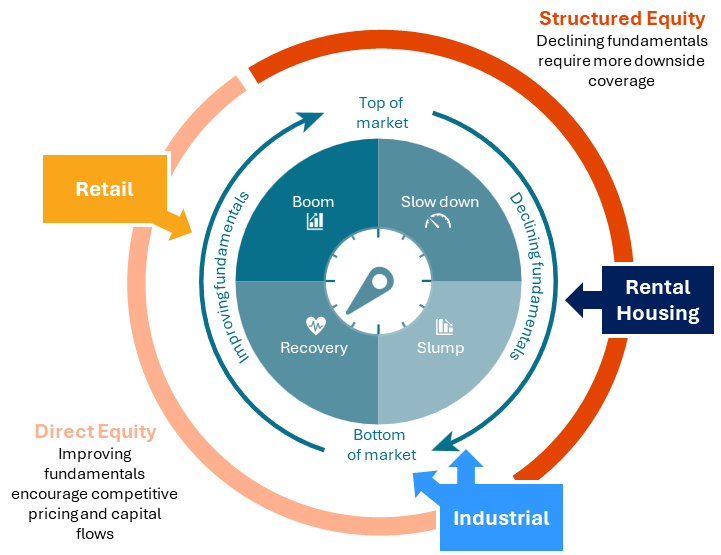
While we believe we are at the beginning of the real estate cycle, not all real estate is equal. This divergence is central to our outlook and shapes how we are deploying capital across the private real estate landscape. Rental housing remains in decline, industrial is near its trough, and retail is in growth mode.
Figure 1: Current Investment Outlook
Source: CenterSquare, as of January 1, 2026.
Rental Housing: Late-Cycle Fundamentals Demand Structured Solutions
Despite improving sentiment in parts of the market, we do not believe rental housing has bottomed. Supply remains elevated and markets need to absorb new 2026 deliveries as well as some 2025 deliveries still in lease-up (Figure 2). At the same time, demand has moderated. Slowing job formation tied to AI-driven workforce shifts and evolving immigration dynamics are weighing on incremental renter growth. As a result, stabilization is likely to take longer than many expect, and we do not anticipate a true bottom until 2027 or later.
Policy uncertainty adds another layer of complexity. Housing affordability has bipartisan focus, and proposals ranging from restrictions on institutional ownership to accelerated development approvals could materially impact fundamentals.
Figure 2: Multifamily Fundamentals Still Challenged

Source: CoStar, as of February 18, 2026.
Importantly, pricing has not fully adjusted to this reality. In some markets, 4-5% cap rates still imply robust future rent growth and exit cap rate compression, leaving little margin for error. In contrast, public multifamily REITs are trading at implied cap rates of 6-6.5%, reflecting these challenged fundamentals. Meanwhile, a refinancing wave is building: loans originated in 2021–2022 at peak valuations and low interest rates are coming due (Figure 3). As senior loan proceeds are reduced to satisfy DSCR and LTV constraints under higher rates and lower valuations, gaps are emerging in the capital stack requiring new equity or structured capital.
Figure 3: Multifamily Loan Maturities by Origination Period

Source: Newmark Research, MBA, Trepp, MSCI Real Capital Analytics, CenterSquare as of January 2026.
Given these dynamics, we believe the best risk-adjusted returns in rental housing today can be achieved by deploying capital through structured investments rather than common equity. Debt-oriented preferred equity and mezzanine investments that provide gap capital offer attractive entry yields, meaningful current pay, and the potential for mid-teens total returns—potentially exceeding equity returns at this stage of the cycle. These investments are secured by high-quality, infill Class A assets with modern amenities and strong sponsorship. This approach prioritizes downside protection while capturing compelling risk-adjusted returns in a volatile environment.
Industrial: Trough Conditions Create Opportunity in Niche Segments
Industrial fundamentals peaked in 2021 and 2022 before softening under the weight of elevated supply. Today, conditions are stabilizing. Absorption has improved, leasing activity has normalized, and supply growth is decelerating. We believe most of the downside is in the rearview, placing industrial near the bottom of the cycle and at the early stages of recovery. Further, surveys show institutional investors continue to view industrial as one of the most appealing property types for 2026, reinforcing its position as a core focus area for capital deployment.
Success, however, we believe depends on differentiation. Rather than competing in the crowded bulk warehouse market, the strongest fundamentals and risk-adjusted returns in the sector exist in a niche product we call essential service industrial (ESI): smaller infill buildings leased to a wide array of local service-oriented tenants whose businesses are integral to the surrounding community. These assets benefit from limited new supply, sticky demand, and lower institutional competition. In fact, in many markets, net supply of this product is shrinking as existing properties are converted into higher and better uses like residential. This segment also demonstrated the most resilient leasing demand in the last few years as the rest of the industrial market digested wavering demand (Figure 4). Altogether, the vacancy for this segment of the market is just 3.6%, compared to 6.7% for the industrial market overall according to data from CBRE.
Figure 4: Annual Leasing Growth by Industrial Segment

Source: CBRE, as of June 30, 2025.
Retail: A Golden Era of Fundamentals
Retail stands apart in the current cycle. The sector did not experience the extreme cap rate compression seen in multifamily and industrial during the post-COVID period, and as a result, entered this cycle at a more rational valuation. Importantly, investor sentiment toward retail is finally turning positive after more than a decade of negativity.
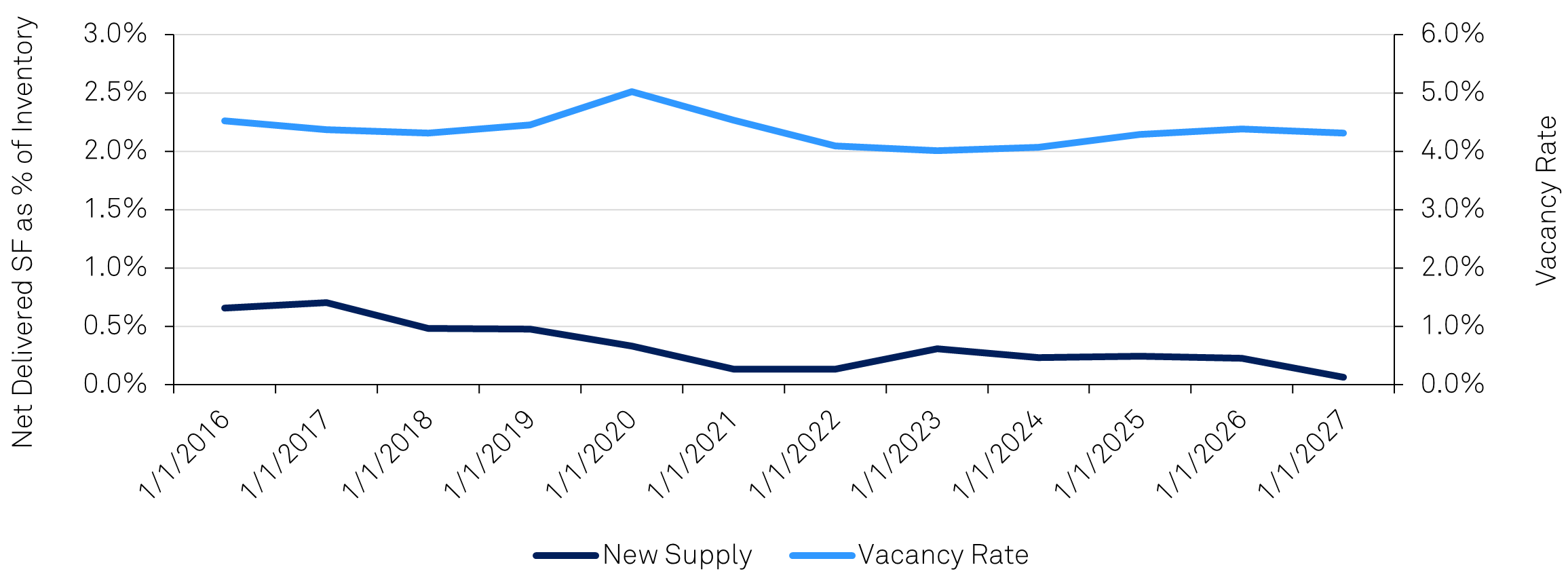
Today, retail fundamentals are the strongest in decades with high occupancies and robust leasing volumes and rental rate growth. The primary driver of this strength is structural undersupply. Over the past two decades, the U.S. population has grown by more than 30 million people, yet retail development has been negligible. This imbalance is now translating directly into pricing power.
While large investors tend to prefer grocery-anchored shopping centers, we believe the strongest risk-adjusted returns remain in a niche subsector of retail called Essential Service Retail (ESR) - unanchored strip centers located at highly trafficked intersections with strong visibility and service-oriented tenants. The lack of investor competition for this property type allows us to deploy capital at compelling valuations that enable core-plus returns with a strong cash-on-cash yield and limited business plan execution risk. Demand for these spaces remains healthy as tenants prioritize locations with strong demographic characteristics and accessibility, and supply remains curtailed, driving durable fundamentals and an attractive long-term growth trajectory (Figure 5).
Figure 5: Lack of Supply Supporting Retail Fundamentals
Source: CoStar, as of February 18, 2026.
Other Pockets of Strength: Data Centers and Senior Housing
While our highest conviction deployment in 2026 remains concentrated in rental housing, industrial, and retail, other segments of private real estate are benefiting from powerful secular tailwinds and attracting growing institutional interest. Two of the most prominent areas are data centers and senior housing, both reflecting structural demand drivers that extend well beyond the traditional real estate cycle.
Data centers continue to stand out as one of the most compelling long-term growth themes in global real assets. Unlike sectors where recovery is driven primarily by supply normalization, data centers are fundamentally demand beneficiaries. The acceleration of cloud computing, artificial intelligence workloads, and digital infrastructure has created what appears to be an insatiable requirement for computing capacity. Institutional investors are increasingly recognizing this dynamic.
At the same time, data centers remain a highly specialized segment of the market. Much of today’s opportunity in the private market is development-oriented, requiring deep technical expertise around power sourcing, cooling technologies, and hyperscaler relationships. As a result, successful investment here depends less on traditional “sticks and bricks” underwriting and more on operating platform capabilities. For many investors, exposure through specialized operators or public REIT strategies may offer a more efficient path than direct private development.
Senior housing also shows strong structural momentum entering 2026. Demographic trends are increasingly supportive as the baby boomer cohort ages into higher-demand years, creating what is often referred to as the “silver tsunami.” After a prolonged period of operational disruption through the pandemic era, fundamentals in many senior housing markets are among the best in the real estate industry, supported by rising occupancy, limited new supply, and growing need-based demand. However, like data centers, senior housing is also operationally intensive, requiring specialized management, staffing, and healthcare-adjacent expertise. Returns in this sector are driven as much, if not more, by operational execution rather than simply the underlying real estate.
Together, these sectors highlight an important feature of the next cycle: some of the strongest opportunities in private real estate are increasingly found in niche, operationally complex segments supported by secular demand drivers.
Conclusion: Alpha, Not Beta
The private real estate opportunity set in 2026 will be defined by dispersion. Investor intentions make clear that capital is returning, but it is returning selectively, with heightened focus on structure, execution, and downside protection. This is not a year for passive beta. It is a year for alpha, earned through specialization, underwriting discipline, and capital stack flexibility. Precision—not momentum—will define performance in 2026.
In 2026, private real estate will reward precision over momentum, structure over speculation, and specialization over scale—alpha will be earned, not assumed.
General Disclosures
Any statement of opinion constitutes only the current opinion of CenterSquare and its employees, which are subject to change and which CenterSquare does not undertake to update.
Material in this publication is for general information only and is not intended to provide specific investment advice or recommendations for any purchase or sale of any specific security or commodity. Due to, among other things, the volatile nature of the markets and the investment areas discussed herein, investments may only be suitable for certain investors. Parties should independently investigate any investment area or manager, and should consult with qualified investment, legal, and tax professionals before making any investment. Some information contained herein has been obtained from third party sources and has not been independently verified by CenterSquare Investment Management LLC (“CenterSquare”). CenterSquare makes no representations as to the accuracy or the completeness of any of the information herein. Accordingly, this material is not to be reproduced in whole or in part or used for any other purpose. Investment products (other than deposit products) referenced in this material are not insured by the FDIC (or any other state or federal agency), are not deposits of or guaranteed by CenterSquare, and are subject to investment risk, including the loss of principal amount invested.
For marketing purposes only. Any statements and opinions expressed are as at the date of publication, are subject to change as economic and market conditions dictate, and do not necessarily represent the views of CenterSquare or any of its affiliates. The information has been provided as a general market commentary only and does not constitute legal, tax, accounting, other professional counsel or investment advice, is not predictive of future performance, and should not be construed as an offer to sell or a solicitation to buy any security or make an offer where otherwise unlawful. The information has been provided without taking into account the investment objective, financial situation or needs of any particular person.
This document should not be published in hard copy, electronic form, via the web or in any other medium accessible to the public, unless authorized by CenterSquare.
CenterSquare REIT Cap Rate Perspective Methodology
CenterSquare REIT Implied Cap Rates are based on a proprietary calculation that divides a company’s reporting net operating income (“NOI”) adjusted for non-recurring items by the value of its equity and debt less the value of non-income producing assets. The figures above are based on Q4 2025 earnings reported in December 2025.
The universe of stocks used to aggregate the data presented is based on CenterSquare’s coverage universe of approximately 200 U.S. listed real estate companies. Sector cap rates are market cap weighted. Sectors and market classifications are defined by the following:
Apartment: REITs that own and manage multifamily residential rental properties; Industrial: REITs that own and manage industrial facilities (i.e. warehouses, distribution centers); Office – REITs that own and manage commercial office properties; Retail – REITs that own and manage retail properties (i.e. malls, shopping centers); Hotel – REITs that own and manage lodging properties; Healthcare – REITs that own properties used by healthcare service tenants (i.e. hospitals, medical office buildings); Gateway – REITs with portfolios primarily in the Boston, Chicago, LA, NYC, SF, and DC markets; Non-Gateway – REITs without a presence in the gateway markets.
The REIT ODCE Proxy is a universe of REIT stocks built to resemble the NCREIF Fund Index – Open End Diversified Core Equity (ODCE). The ODCE, short for NCREIF Fund Index - Open End Diversified Core Equity, is the first of the NCREIF Fund Database products and is an index of investment returns reporting on both a historical and current basis the results of 36 open-end commingled funds pursuing a core investment strategy, some of which have performance histories dating back to the 1970s. The REIT ODCE Proxy is proprietary to CenterSquare and uses gateway/infill names in apartments, retail, industrial and office, and then weights them according to the ODCE index to create a proxy.
Private Market Cap Rates represent the cap rate achievable in the private market for the property portfolio owned by each company, and are based on estimates produced by CenterSquare’s investment team informed by various market sources including broker estimates.