Corner Insights – In an Uncertain Market, Defensible Strategies Stand Out
April 2026

Welcome to CenterSquare’s Corner Insights Column, bringing you updates on what’s happening across the real estate landscape.
In an Uncertain Market,
Defensible Strategies Stand Out
Not all industrial is created equal— and while headline vacancy climbs for the sector, one niche segment is operating on a structurally different set of rules.
Key Takeaways
Investors are approaching capital deployment more deliberately, prioritizing strategies with constrained supply, durable tenant demand, and low concentration risk. Essential Service Industrial exhibits all three.
• Overall industrial vacancies have risen to 6.7%, but spaces under 25,000 SF sit at just 3.6%, which is among the lowest reading in the sector.
• CenterSquare's ESI strategy focuses on multi-tenant infill assets with sub-10,000 SF suite sizes, where new supply is structurally limited, and tenant demand is anchored by community-facing businesses.
• Multi-tenant structure distributes risk broadly: no single tenant creates outsized exposure, and re-leasing costs are modest when turnover occurs.
• A meaningful share of ESI assets still carries below-market leases, with in-place rents moving toward market as those leases roll.
Investors today are approaching capital deployment more deliberately; scrutinizing hold periods, demanding clearer exit visibility, and gravitating toward strategies with a track record of performing under stress. That posture is rational. And it points toward a specific set of attributes: constrained supply, durable tenant demand, and low concentration risk.
The Broader Industrial Market Is Resetting, But Not Uniformly
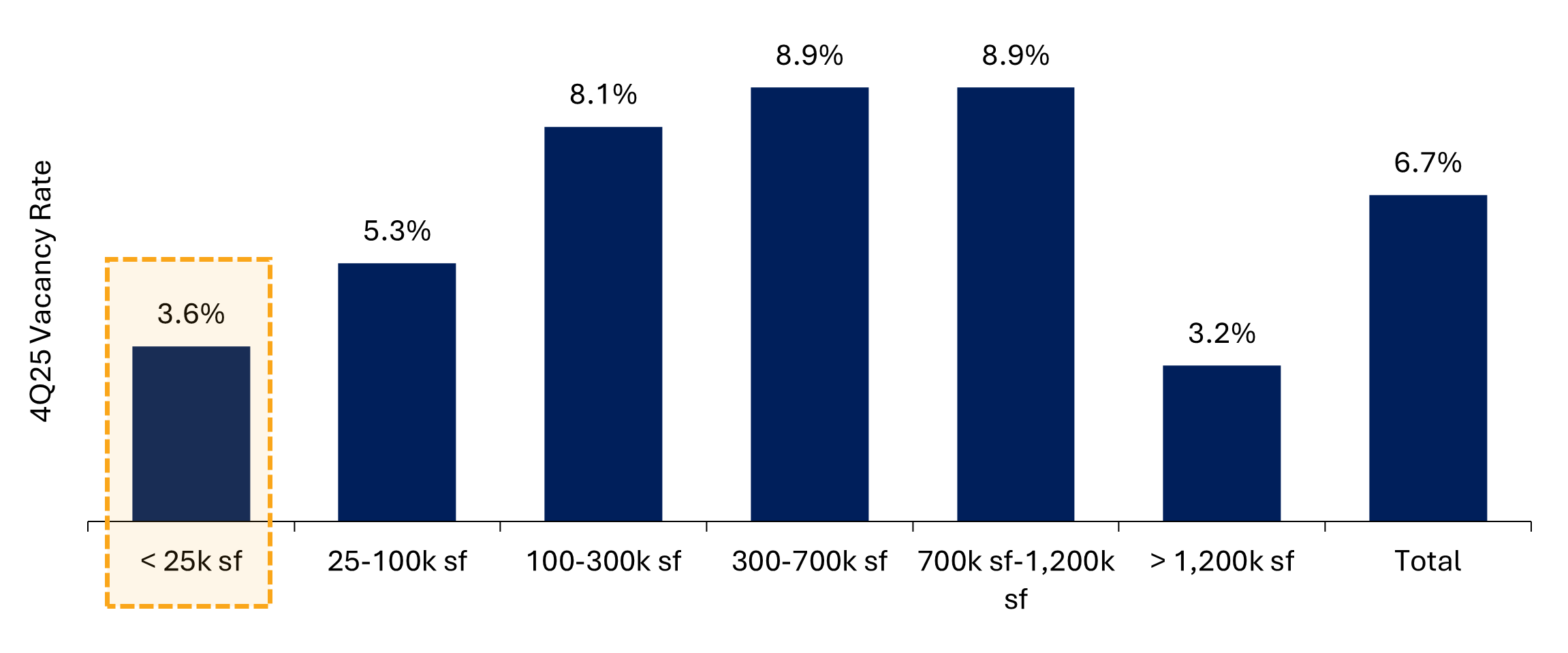
Source: CBRE, Economic Advisors, as of Q4 2025.
Overall industrial vacancies have risen to 6.7% as new supply works through the market. For investors in large-format distribution and logistics assets, the reset is real. But headline vacancy obscures a meaningful divergence within the sector.
3.6%
Vacancy for industrial spaces under 25,000 SF
While overall industrial vacancy has climbed to 6.7%, small-bay assets remain exceptionally constrained. Tenant demand for suites under 10,000 SF has accounted for over 60% of new industrial lease activity since 2010, while leasing for large-format industrial has fallen nearly 35% from its 2022 peak.
There is a clear divergence in the industrial sector, highlighting the opportunity in Essential Service Industrial (ESI).
Why Small-Bay Industrial Supply Remains Structurally Constrained
CenterSquare’s ESI strategy focuses on multi-tenant infill assets with sub-10,000 SF suite sizes in dense, infill markets. In these locations, supply is not just tight; it is structurally difficult to replenish. Land is scarce, zoning often favors residential or large-format commercial uses, and construction economics make smaller footprints less efficient for developers to build. Due to the infill nature of essential service industrial product, existing product is frequently repurposed into other higher and better uses, generally residential, resulting in net demolitions and decreasing supply.
Essential Tenants, Durable Demand
Businesses that occupy ESI properties are not discretionary occupiers. Their space is embedded in how they work: where they stage materials, park vehicles, store equipment, and dispatch crews. When a building has the right strategic location and configuration, there is always a tenant in line to fill the space.
That dynamic is well-documented on the ground. In our Front & Center podcast Ep. 76 – Resilient by Design: The Case for Essential Service Industrial leasing brokers across Phoenix, Indianapolis, and Atlanta described the same pattern: when a well-configured suite comes available, it moves in 30 to 60 days because demand is consistent and alternatives are limited. One broker noted that for tenants needing a truck well and sub-10,000 SF suites, there are literally only two options in the market, making the leasing decision straightforward and fast.
Portfolio Diversification as a Structural Feature
With average suite sizes sub-10,000 square feet, no single tenant drives outsized exposure. The portfolio distributes risk across a broad base of operators, similar in structure to multifamily, where concentration risk is mitigated by diversification across many small units rather than dependence on a few large ones. When turnover occurs, tenant improvement costs are modest as similar operators are often competing for the limited available space.
What the Repricing Cycle Means for Investors
A meaningful share of ESI properties still carry below-market leases. As those leases roll, in-place rents are gradually moving toward current market rates, which have reached all-time highs nationally in the small-bay space. ESI leasing brokers have noted that after years of short-term renewals, tenants are beginning to commit to longer terms, a sign that operators have accepted today’s market conditions and are planning accordingly.
No strategy is without risk, and real estate performance is not guaranteed. But for investors seeking strategies with repeatable operating characteristics, low single-tenant exposure, and a supply picture that is difficult to change quickly, Essential Service Industrial warrants a close look.
Interested in deploying capital in our Essential Service Industrial Strategy? Learn more here.
Bottom Line for Allocators
Small-bay industrial at 3.6% vacancy operates in a fundamentally different environment than the broader industrial market at 6.7%. The new supply wave is not reaching this segment.
Infill land scarcity, zoning, and construction economics make it difficult to add meaningful new small-bay inventory. This is not a temporary condition.
Multi-tenant structure across essential, community-facing operators distributes risk broadly, with modest re-leasing costs when turnover occurs.
These materials are not to be reproduced or redistributed in whole or in part without the prior written consent of CenterSquare.